
Salt Air and Sand: Specifying Window and Door Hardware for Coastal San Diego
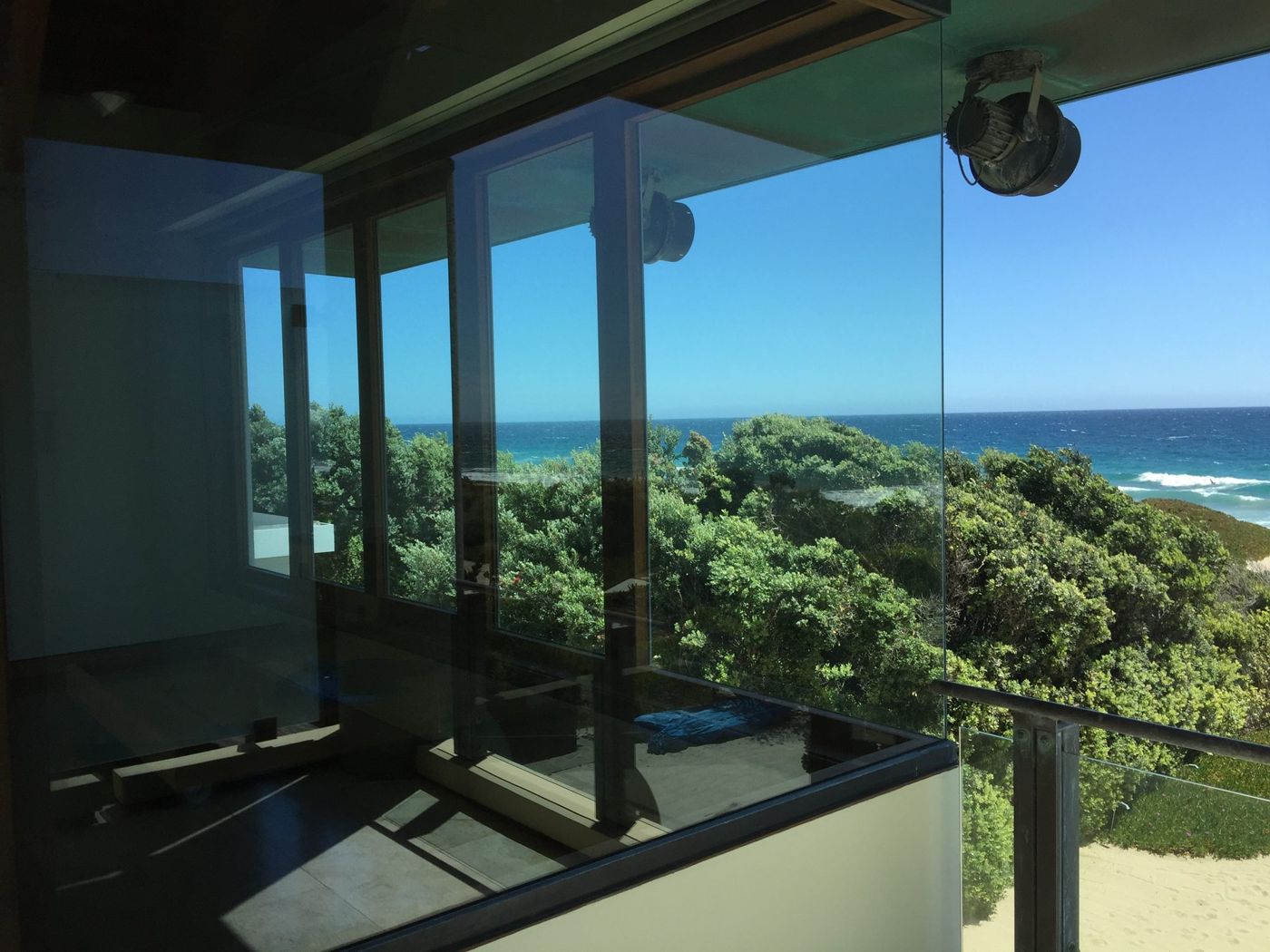
Near the coast, specify an AAMA 2605 finish on aluminium rather than the 2603 baseline, and 316 (marine grade) stainless rather than 304 for exposed fasteners and hardware. Then rinse exposed hardware and tracks with fresh water on a schedule. Specification and maintenance both matter — neither alone is enough.
Coastal San Diego is a harder environment for windows and doors than most homeowners realise, and harder than a lot of standard specifications assume. The failures we get called to along the coast are rarely dramatic. They are hardware that has stiffened, fasteners that have bled rust down a frame, and finishes that have chalked years earlier than they should have.
Almost all of it is avoidable at specification stage, and much of the rest is avoidable with a hose.
Why salt air is different from ordinary weather
Airborne salt is not simply moisture. Chloride ions are aggressive to metals in two specific ways:
- They break down passive layers. Aluminium and stainless steel both rely on a thin self-repairing oxide layer for corrosion resistance. Chlorides attack that layer locally, producing pitting corrosion — small, deep points of attack rather than uniform surface rust. Pitting is what seizes a roller bearing or a lock cylinder.
- They make the surface conductive. A salt film turns condensation into an electrolyte, which drives galvanic corrosion wherever two dissimilar metals are in contact. A steel screw in an aluminium frame is a slow battery.
Add wind-driven sand, and you also get mechanical abrasion that removes protective coatings and grinds moving parts — which is why coastal sliding doors chew through rollers faster. We cover that failure path separately in our guide to sliding glass door roller replacement.
Finishes: what AAMA 2603, 2604 and 2605 actually mean
Architectural aluminium finishes are graded against three specifications published by AAMA, now maintained by the Fenestration and Glazing Industry Alliance. Almost every aluminium window and door quote you receive will sit in one of these tiers, and the tier is often not stated unless you ask.
| Spec | Performance level | Typical resin | Where it belongs |
|---|---|---|---|
| AAMA 2603 | Baseline | Standard organic coatings | Interior, or protected non-coastal exterior |
| AAMA 2604 | High performance | ~50% PVDF | General exterior, inland |
| AAMA 2605 | Superior performance | ~70% PVDF | Coastal and severe exposure |
The tiers differ in resistance to colour change, chalking, gloss loss, humidity and corrosion. AAMA 2605 is the one written for the conditions that exist within sight of the water.
The testing detail worth knowing
For a long time these specs were compared on hours of continuous salt spray under ASTM B117. AAMA 2604 still uses that method. AAMA 2605 no longer does — it moved to ASTM G85, Annex A5, a cyclic corrosion test.
That change is not a technicality. Continuous salt fog keeps a sample permanently wet, which is not what happens on a real building. A cyclic test alternates wet and dry phases, and the drying phase is where salt concentrates on the surface and does much of its damage. G85 A5 is a better model of a coastal wall, which is precisely why the top tier adopted it.
The practical consequence: do not compare finishes by salt-spray hours across specs. A 2604 quoted at 3,000 hours of B117 and a 2605 tested to a shorter G85 A5 cycle are not on the same scale, and the shorter number is the more demanding test. If a supplier is selling you on raw hours, they are comparing the wrong things.
Fasteners and hardware: 304 versus 316 stainless
Use 316, not 304, for anything exposed within about a mile of the coast. The difference is 2–3% molybdenum in 316, which is specifically what improves resistance to chloride pitting. 304 is a perfectly good stainless in most of the country and a poor choice on the water.
This is the single most common specification miss we see. "Stainless steel" on a quote means very little on its own — it is a family of alloys, not a grade. Ask which one.
Other points that matter more near the coast than inland:
- Do not mix metals casually. Where stainless fasteners meet aluminium, use isolation washers or an appropriate sealant to break the galvanic path.
- Watch the hidden components. A door can have a beautiful marine-grade exterior handle and a plain steel spring or roller axle inside the assembly. The concealed parts fail first because nobody rinses them.
- Passivation matters. Properly passivated 316 substantially outperforms the same alloy left contaminated by machining.
- Powder coating over stainless is not a substitute for the right alloy. Once the coating is chipped by sand, the substrate is what is left.
How often should you rinse?
Manufacturers commonly define a "seacoast" or "severe marine" zone and tie warranty terms and maintenance intervals to it. The exact boundary varies by manufacturer, but as working guidance for San Diego:
| Distance from the water | Fresh-water rinse of frames, tracks and hardware |
|---|---|
| Direct ocean frontage / heavy spray | Monthly |
| Within roughly a mile | Quarterly |
| 1–5 miles inland | Twice a year |
| Further inland | Annually, with normal cleaning |
"Rinse" means plain fresh water and a soft cloth or brush on frames, sills, tracks, weep holes and exposed hardware. Not solvents, not abrasive pads, not a pressure washer — pressure drives water past weatherseals and can force salt deeper into hardware rather than removing it.
Two things people miss: clear the weep holes at the bottom of the frame, because blocked weeps hold salt water against the sill indefinitely; and rinse the tracks, because that is where sand accumulates.
Check your specific manufacturer's maintenance schedule as well. Coastal warranty terms are often conditional on documented maintenance, and a missed schedule is a common reason a claim gets declined.
What to ask for when you are specifying
- "Which AAMA finish spec is this — 2603, 2604 or 2605?" If the answer is not immediate, the finish is probably not 2605.
- "Which stainless grade are the exposed fasteners and hardware?" You want to hear 316.
- "Is there a coastal or seacoast option on this product line?" Many manufacturers have one. It is rarely quoted by default.
- "What does the warranty require of me in a coastal location?" Get the maintenance schedule in writing at purchase, not at claim.
- "What are the concealed components made of?" Rollers, axles, springs, screws behind the trim.
Is a coastal specification worth the premium?
For a house on or near the water, generally yes — not because the frames fail, but because the hardware does, and hardware failure is what makes a door unusable. The upgrade cost sits mostly in finish and fastener specification at order stage. Replacing seized rollers, corroded locks and pitted handles across a house several years early costs considerably more, and comes with the disruption of the work.
Further inland, the calculation changes and AAMA 2604 with good maintenance is usually a reasonable specification.
The short version
- Chlorides cause pitting and drive galvanic corrosion — different from ordinary weathering.
- Specify AAMA 2605 finishes near the coast; 2604 inland.
- Do not compare finishes on salt-spray hours across different specs — 2605 uses a different, more realistic cyclic test.
- Specify 316 stainless, not 304, for exposed hardware and fasteners.
- Isolate dissimilar metals; ask what the concealed components are.
- Rinse with fresh water on a schedule, keep weep holes clear, and keep tracks free of sand.
We install and service window and door systems throughout coastal San Diego County, including large-format and European door systems and specialty hardware repair. If you are specifying for a coastal site and want a second opinion on a quote, send it over.
Sources
- Fenestration and Glazing Industry Alliance (FGIA), AAMA 2603 / 2604 / 2605 voluntary specifications for organic coatings on aluminium extrusions and panels.
- ASTM B117, Standard Practice for Operating Salt Spray (Fog) Apparatus — ASTM International.
- ASTM G85 Annex A5, Standard Practice for Modified Salt Spray (Fog) Testing — Dilute Electrolyte Cyclic Fog/Dry Test — ASTM International. The cyclic method adopted for AAMA 2605 in place of continuous B117 exposure.
- The Construction Specifier, “Aluminum-framed fenestration: A guide to specifying paints and coatings” — comparison of the AAMA finish tiers and their test regimes.
- Window + Door, “6 Coating Considerations for Coastal Communities”.
- Nickel Institute / ASTM A240 alloy data on austenitic stainless grades — the 2–3% molybdenum addition distinguishing 316 from 304 and its effect on chloride pitting resistance.
Sources checked August 2026. AAMA/FGIA specifications and ASTM standards are periodically revised, and manufacturer coastal warranty terms vary — confirm the current edition and your specific product warranty before specifying.
Specifying for a coastal site?
Send us the quote or the product line. We will tell you whether the finish and hardware specification will survive where you are putting it.